
How Do You Get to DAM 4.0?
In the last decade of Real Story Group's coverage of the Digital Asset Management (DAM) marketplace, we’ve seen a marked transition in the complexity of vendor capabilities and buyer objectives. The DAM universe is now segmented into four distinct categories that we label DAM 1.0, 2.0, 3.0, and 4.0.
Enterprises typically want to move themselves along this spectrum, albeit to varying degrees and with different sorts of business cases. And not surprisingly, DAM platforms in the marketplace also tend to spread out along a complexity spectrum, and therefore usually cater to buyers in just one of these phases.
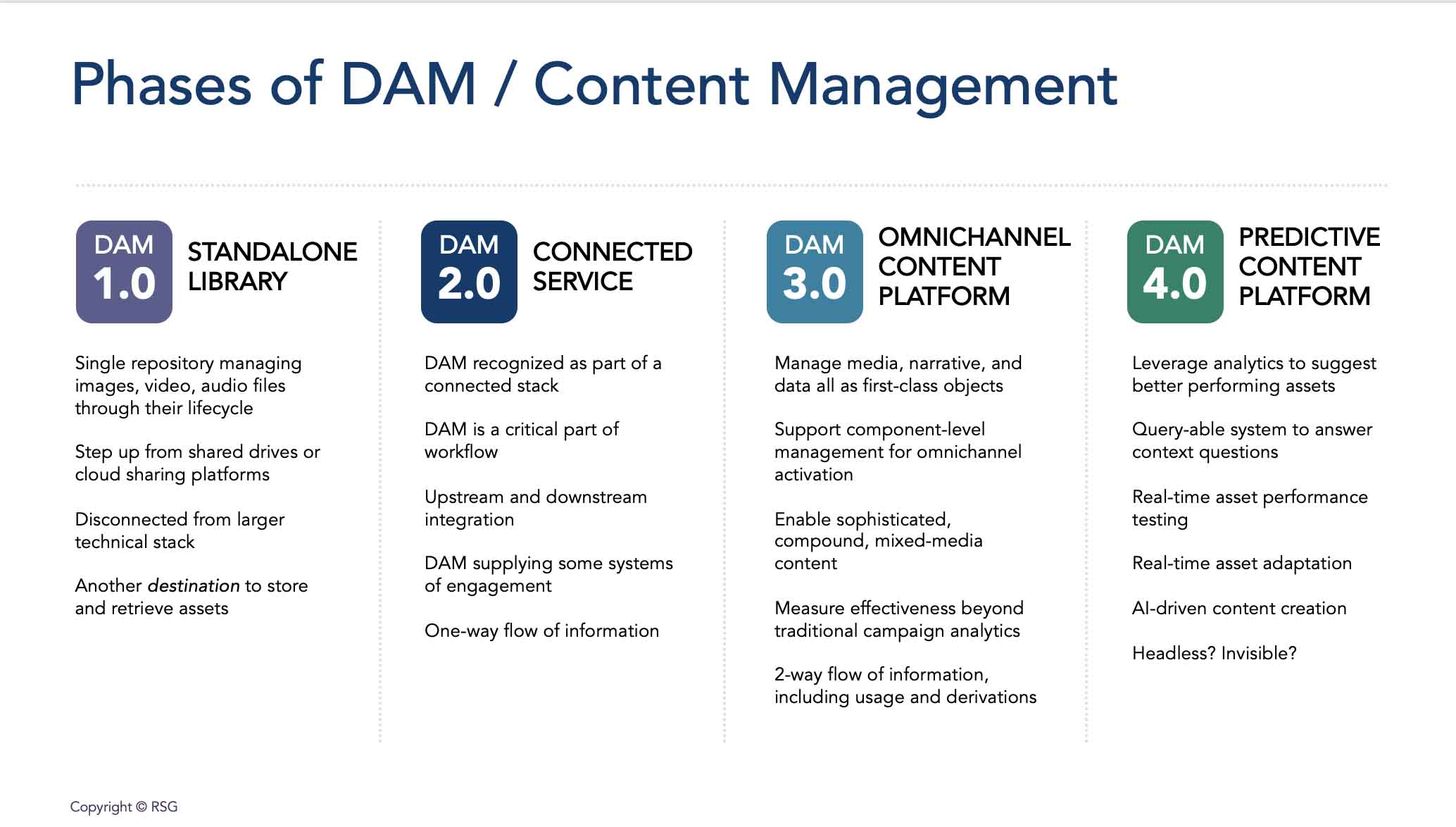
As a DAM technology customer, you'll want to honestly assess where your enterprise sits on this maturity spectrum and where you realistically want to get in the next few years. Once you make this assessment, you can identify DAM technology that will help — not hinder — you from taking the next steps. Let's briefly review each phase.
DAM 1.0: DAM as a basic library
The hard truth is that many enterprises are still at DAM “Zero,” with assets scattered across the enterprise in a multitude of shared drives, cloud file-sharing services, or on personal devices.
So a first step in your DAM journey is employing a unified system to serve as a single location for an asset to reside throughout its lifecycle. A packaged Digital Asset Management system can help you manage images, video, and audio files from ingestion to publication to archive.
DAM 1.0-level enterprises have a unified system that serves as a library, where staff can go to check-in and check-out assets. This can prove a significant improvement over an uncategorized mess you endured before.
While a DAM 1.0 library is an essential starting point, you’ve potentially just created another (albeit better) silo of content in your enterprise. The DAM is just another destination to store and retrieve assets. In order to actually do something with these assets, you need to activate them from the DAM.
DAM 2.0: DAM as a marketing tech service
For years, digital asset management was either not included or marginalized in the marketing technology conversation. People viewed DAM as the tool of creatives, brand managers, and even (wait for it…) librarians.
Today, most enterprises recognize that DAM resides firmly in the MarTech conversation…and the MarTech stack.
In a DAM 2.0 model, the system becomes a critical part of the asset creation workflow as well as an authoritative direct source for diverse engagement environments. Serving as the repository of record for work-in-progress and/or completed assets, it is integrated with upstream content creation systems and downstream systems of engagement.
Designers store their work products within the DAM directly from their creative tools. Marketers who spend their days creating experiences in systems like web content management, marketing automation, e-commerce, or social publishing tools can pull or reference assets directly from the DAM.
The most mature DAM 2.0 implementations are characterized by a smooth flow of content from creatives through to customer touchpoints where the DAM is often invisible to key participants, including marketers.
Still, a key limitation for most DAM 2.0 deployments is that this flow of content is uni-directional and missing opportunities to integrate analytics in a meaningful way. Moreover, these implementations remain limited to binary image and media files, perhaps with some associated “copy,” so they typically don’t cover the full breadth of your marketing and customer experience micro-content.
DAM 3.0: An Omnichannel Content Platform
In recent years, many enterprises have worked hard to modernize and optimize their marketing and digital experience technology stacks. In most cases, however, silos still persist, and enterprises struggle to provide coherent customer experiences and campaigns across touchpoints.
One way some forward-looking firms are trying to combat content silos is by employing an “omnichannel content platform” or OCP. RSG evaluates a large handful of OCP vendors, nearly all of whom have emerged out of the DAM market.
The purpose of an OCP is to act as a single source of truth for a highly curated set of reusable enterprise-wide information assets – typically componentized assets – such as text, data, and media. An OCP manages and distributes the core assets of an enterprise — not all assets, but a select subset needed to provide consistent customer experiences across channels.
In addition to managing media, narrative, and data all as first-class objects, a key feature of a DAM 3.0 system is the introduction of two-way flow of information. For example, robust OCPs should be able to track deployments (including automated pulls) as well as ingest and display enterprise analytics in context.
Finally, OCPs need to be able to manage complex parent-child relationships:
Between core assets and their many channel-specific derivatives (e.g., the shorter Twitter rendition of a foundational marketing video); and Between core assets and where they get included in compound assets (e.g., an image in a video).
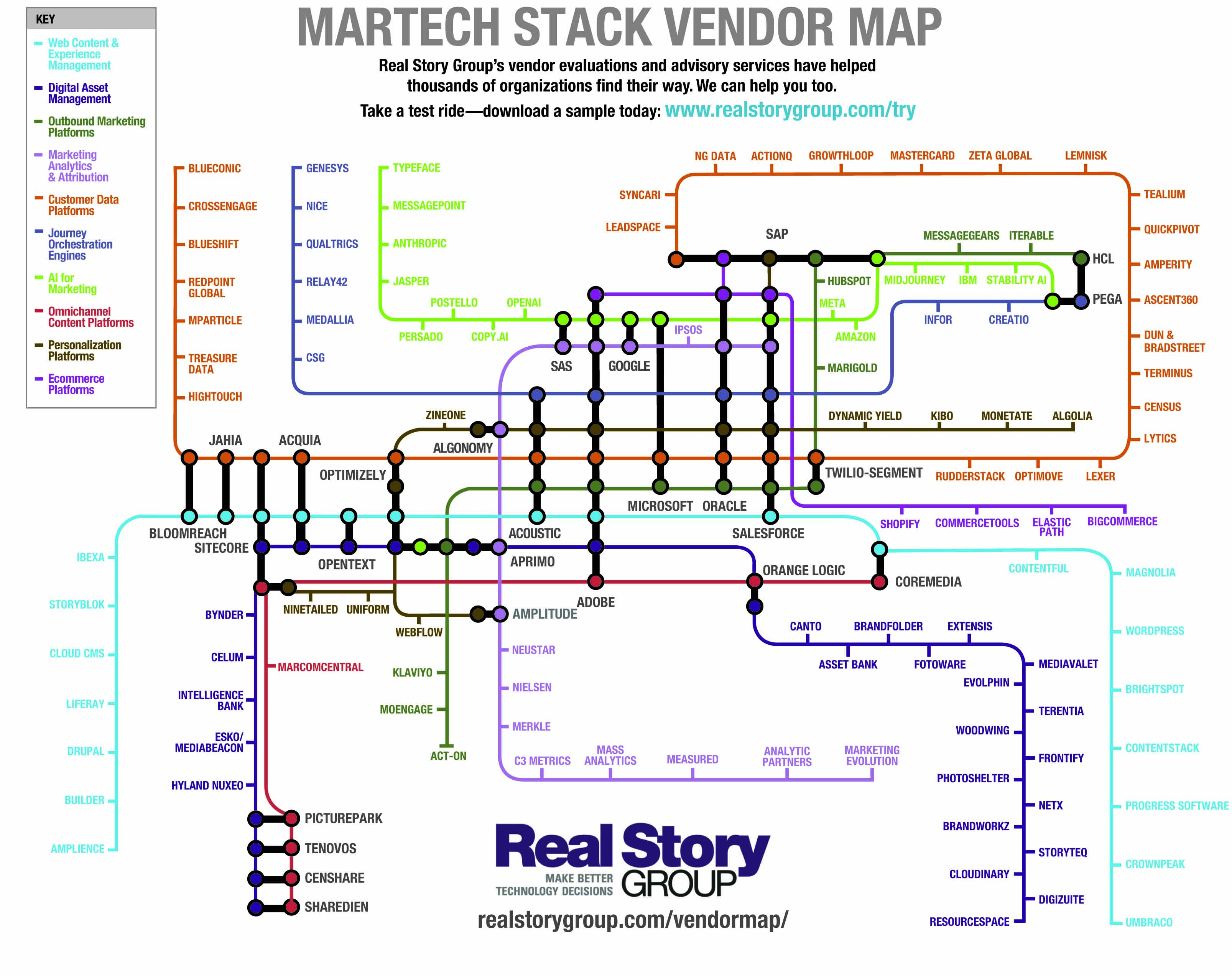
In technology terms, this means that OCPs need to be fully "object oriented," and it turns out that few DAM platforms are built this way. On RSG's subway map, we break out OCP as a separate (red) line, to distinguish from the DAM (purple) line, though you’ll notice some substantial overlap.
DAM 4.0: Predictive Platform
The next evolution of enterprise content platforms aims to move beyond reactive content strategies and toward proactive, intelligent experiences for prospects and customers, ultimately facilitated via AI.
A true DAM 4.0 system empowers managers to ask complex contextual questions and receive data-driven insights that enhance decision-making. For instance, a marketer could query, "Which asset is likely to perform best among women in Canada aged 45-55?" and receive an informed recommendation based on advanced analytics. By analyzing historical trends alongside real-time data, the system identifies high-performing assets and continuously optimizes content selection, ensuring that businesses always deliver the most relevant and effective messaging.
Beyond intelligent recommendations, a predictive content platform takes optimization a step further by incorporating real-time asset testing and adaptation. The platform continuously evaluates performance metrics, automatically adjusting content elements to maximize engagement and effectiveness.
AI-driven content creation enhances efficiency by generating personalized, high-quality assets on demand, reducing the burden on creative teams while maintaining a high level of customization. Of course this is much easier said than done!
As a headless layer in stack, the platform should integrate closely into existing workflows, delivering real-time content modifications and intelligent recommendations without disrupting the user experience – while still enabling human-in-the-loop (or lawyer-in-the-loop) reviews.
The Right Partner for Your Content Journey
Every enterprise lives within one stage of this DAM maturity spectrum, but no one has reached their final destination. Even the most sophisticated enterprises are constantly trying to improve the way they can improve customer experiences with the most impactful content.
Like it or not, the DAM marketplace is quite fragmented with regard to vendors' capabilities to serve each of these phases. I've definitely seen cases where enterprise ambitions have gotten throttled by their incumbent DAM vendor. By the same token, I've seen enterprises overbuy this technology. An object-oriented, DAM 3.0 (OCP) toolset necessarily brings much more complicated interfaces and integration requirements, and a firm that's unprepared for this complexity will see negative returns here.
So figure out where you are today, and judge where you'll likely end up in the mid-term, and make technology choices accordingly. As always, our team at RSG can help you make better decisions, faster.