Three Routes to a Content Warehouse
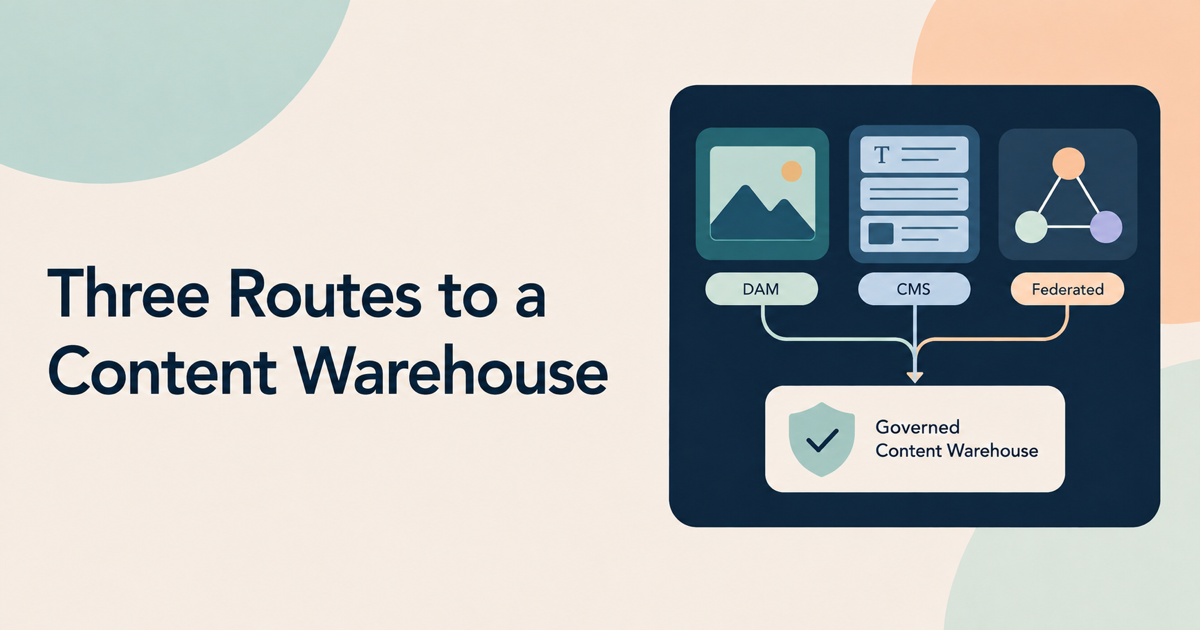
Most enterprises will not buy a content warehouse as a finished product. They will build toward one by extending an existing DAM or CMS, or by connecting authoritative repositories through a federated services layer. The harder question is where to start.
In an earlier article, I described a “content warehouse” as a governed foundation for reusable content objects. Such a warehouse is an important precondition for DAM 3.0 and essential for DAM 4.0 or, for that matter, any serious content-rich AI services.
Consider a product claim, for example, which should carry its approval state, source, expiry date, permitted uses, required disclosure, and critically its relationships to other content and data. When an AI service retrieves that claim, it should receive those conditions as well, rather than reconstructing them from a PDF, a prompt, or somebody's memory.
For example, an insurer might make the following product claim:
“This plan provides worldwide emergency medical coverage.”
The sentence cannot safely travel alone. It may be approved only:
- For a specific insurance plan and country;
- Until a particular date;
- For certain customer segments or channels;
- When accompanied by a disclosure such as “subject to policy limits and exclusions.”
A content warehouse would store the claim together with those conditions. When an AI assistant uses it in an email or web screen, it receives both the sentence and the rules governing its use. Otherwise, the AI may extract the sentence from an old PDF, omit the required disclosure, or apply it to the wrong product.
Most large enterprises already own pieces of this. Their DAM holds approved media. The CMS manages web modules. Product facts sit in another system, while legal approvals may be recorded in a workflow or email. What they usually lack is a dependable way for downstream systems to query these sources as one governed content context.
This is where a content warehouse can prove handy. However, 2026 finds us with no mature content warehouse product category waiting to fill that gap. So the natural question is: What should you build?
I’ll suggest you start from your current stack state and look at three broad approaches. Of course, as always, you may end up with more than one or a hybrid combination of these, so think of these as patterns.

1. Start with the DAM
A digital asset management (DAM) system can offer a reasonable starting point when already holding approved images, video, narratives, and other media. Some higher-end DAMs can further manage variants, derivatives, usage rights, approval states, and fairly complex relationships among assets.
The trouble is that many DAM implementations still think in terms of assets and folders. They can locate the approved brochure but cannot expose the approved benefit statement inside it as a reusable object. Image rights may be well managed while a more involved rule is not: this statement is valid in these jurisdictions, for these audiences, only with this disclosure, until this date.
Some products RSG has classified as Omnichannel Content Platforms (OCPs) mitigate some of those issues. Clients have tried to use them as master repositories for structured, reusable content across channels. This is relevant to a content warehouse, although vendors have made limited progress in developing the technology.
Before extending the DAM, test those cases directly. Can it represent the relationship? Can another application query the rule? Does the rule travel with the content when it leaves the DAM?
If the system passes those tests and already has strong enterprise adoption, giving it a larger role could prove the least disruptive route.
2. Start with the CMS
The CMS may be a better foundation when the enterprise's most mature structured content already lives there. CMS platforms generally handle modular text and experience assembly better than traditional DAMs. CMS platforms can also separate content from presentation, which helps with reuse.
Their heritage is important, though. Most Web CMS platforms were built around pages, screens, and publishing workflows, even when the delivery layer is now headless. Email modules, service scripts, advisor tools, sales documents, and AI assistants do not always fit comfortably into that model. Likewise, they tend to treat image and media assets as second-class citizens, relegated to a dependent library.
Test whether the CMS can separately govern where a passage may be used, how it may be adapted, and which disclosure must accompany it. They may have publication status, but that is just a weak proxy for these considerations. A passage marked "published" may still have restrictions on shortening, translation, combination with other claims, or use in a regulated context. Those rules need to be modeled and made available to consuming systems.
I would consider a CMS-led route when structured text is the center of gravity. But I would test it against non-web channels early, before a web-oriented content model quietly becomes the enterprise model.
3. Build a content services layer across the current repositories
This is my preferred starting point when several systems need to remain authoritative. It assumes that your content is already distributed and much of it will stay that way.
The DAM can remain authoritative for media, the CMS for web-shaped components, and a PIM or equivalent for product facts. Claims and disclosures may have their own review process. A content services layer provides a governed way to find and query those objects without first moving them all into one repository.
This layer would normalize enough metadata to expose approval, freshness, rights, lineage, relationships, and permitted use. A consuming system could request content eligible for a particular task and receive the constraints along with it.
A lot of work is needed behind the scenes. Someone still has to declare which source is authoritative for each type of content. Conflicting approval models and metadata need to be reconciled. Connectors require maintenance whenever a source platform changes. Adding a graph and a set of APIs does not settle any of that.
Even so, federation is usually more doable than a program to migrate every useful content object into one new platform.

Begin with a simple but real example
Start small, and then scale up. Pick two or three cases that are difficult today.
Consider a regulated offer where one benefit statement requires a particular disclosure. Or take a product update that must reach email, the website, service scripts, and sales material. Map where each content object comes from, who approves it, what it is related to, and which systems consume it.
Now look for the smallest useful change to the current stack. Perhaps the DAM needs a richer object model. Or the CMS needs to expose structured modules outside the web channel. Perhaps neither system can span the sources, which makes a services layer necessary.
This exercise also tends to uncover mundane problems that architecture diagrams hide. No one owns the canonical claim. Two systems both appear authoritative. Legal approval is recorded in email. A regional team can update copy without triggering changes elsewhere. Buying another repository will not repair those problems.
Who runs it?
Once content is broken into reusable claims, disclosures, images, and modules, someone has to maintain the model and the rules that connect them. Creative teams understand the content but may not own policy or taxonomy. Technology teams can build services but cannot infer which disclosure belongs with which claim.
I would expect most enterprises to begin with a cross-functional operating model rather than a large new department. But the content model, taxonomy, source authority, policy rules, and platform services all need named owners. If those responsibilities remain distributed and informal, the new layer will soon become another unreliable index.
Final Recommendation
Start with the platform that already governs most of the content required for an important scenario. If extending your DAM or CMS can support the scenario, it will usually deliver value faster than building an enterprise-wide content services layer.
However, do not force the platform (DAM or CMS) to become the master for every kind of content. If your scenario requires several systems that need to remain authoritative, consider federation to connect them. Your content warehouse may eventually become a federated services layer, but let your requirements drive that evolution.
If you’re deciding whether to extend your DAM, extend your CMS, or connect existing repositories, RSG can help you test those options against real content scenarios before you commit to a platform or architecture. Contact us to discuss your content-warehouse roadmap.